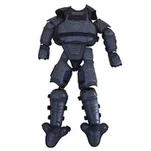
While primarily designed for ballistics and fragmentation, shields used by EOD (Explosive Ordnance Disposal) technicians must also account for the effects of a blast overpressure, or shockwave. A high-explosive blast generates a supersonic wave of pressurized air that can cause catastrophic internal injuries, including pulmonary embolisms and organ rupture, without any visible trauma. EOD shields are engineered to mitigate this. They are significantly larger and heavier than standard ballistic shields, designed to allow the technician to crouch completely behind them. The shield is angled to deflect the force of the blast wave around the operator, rather than taking it head-on. The materials and construction are designed to remain intact and not fragment upon being struck by the blast wave. The shield is also mounted on a mobile platform with wheels, allowing the technician to maintain a safe distance from the ordnance while still having a large protective barrier. This design focuses on creating a protected space that reduces the overpressure experienced by the operator to survivable levels.
Core Knowledge:
Blast Overpressure: The invisible shockwave from an explosion is a primary killer, causing internal damage to lungs, ears, and the brain. Protection involves mitigating this pressure.
Size and Angle: EOD shields are very large and are often angled to deflect and dissipate the energy of a blast wave around the sides of the shield, rather than stopping it outright.
Structural Integrity: The shield must not break apart when struck by the blast wave, as secondary fragmentation from the shield itself would be lethal.
Distance: The shield is wheeled, allowing the operator to engage threats from as far away as possible, as blast overpressure decreases significantly with distance.